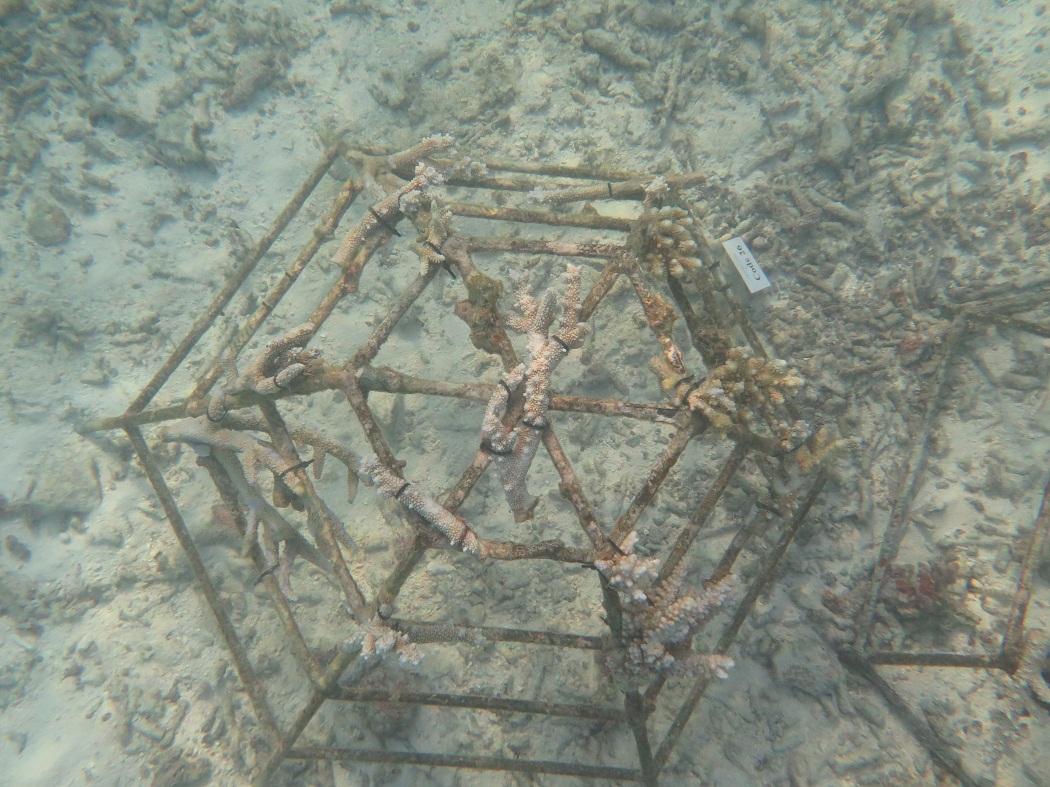
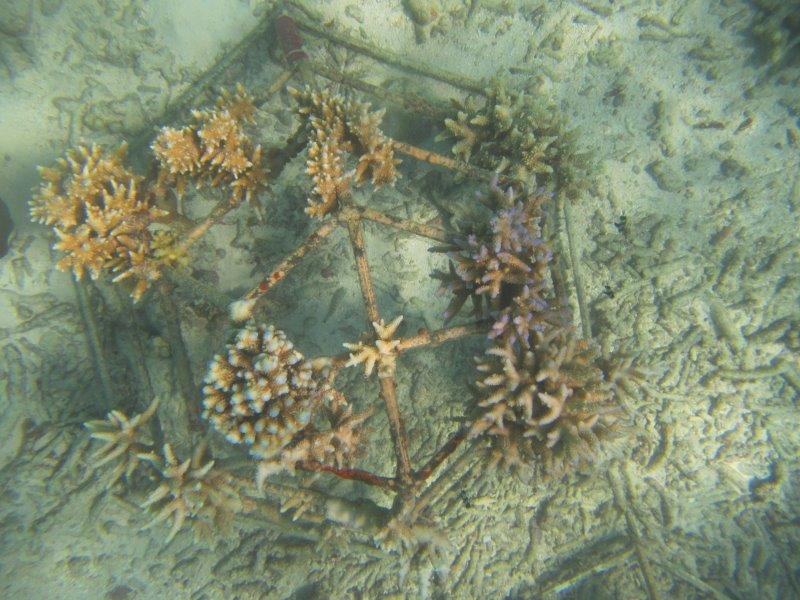
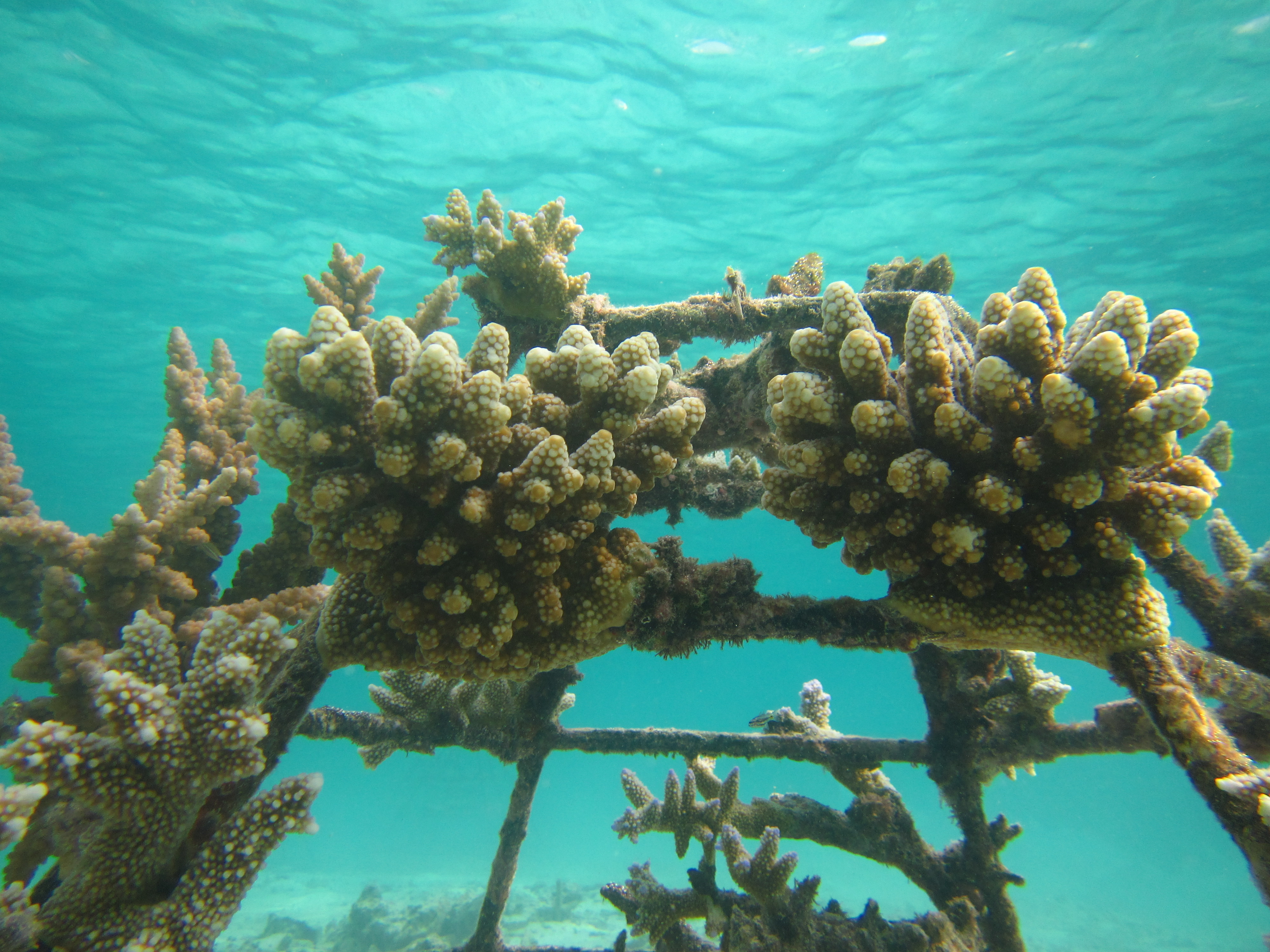
Thank you for signing up to keep in touch with the Coral Conservation Project. Pictured above, you will find your coral frame as it was few days after construction. Your personal page will allow you to see more regular updates and amazing facts about the corals and animals living on your frame. By now having all the updates on one page, seeing the progress of your frame will be much easier and convenient. If you want to satisfy your curiosity even more, you can take a look at our Marine Blog Life and videos from the Marine Lab Diary or connect with us for more information.
Here is the start of a healthy coral reef relationship!
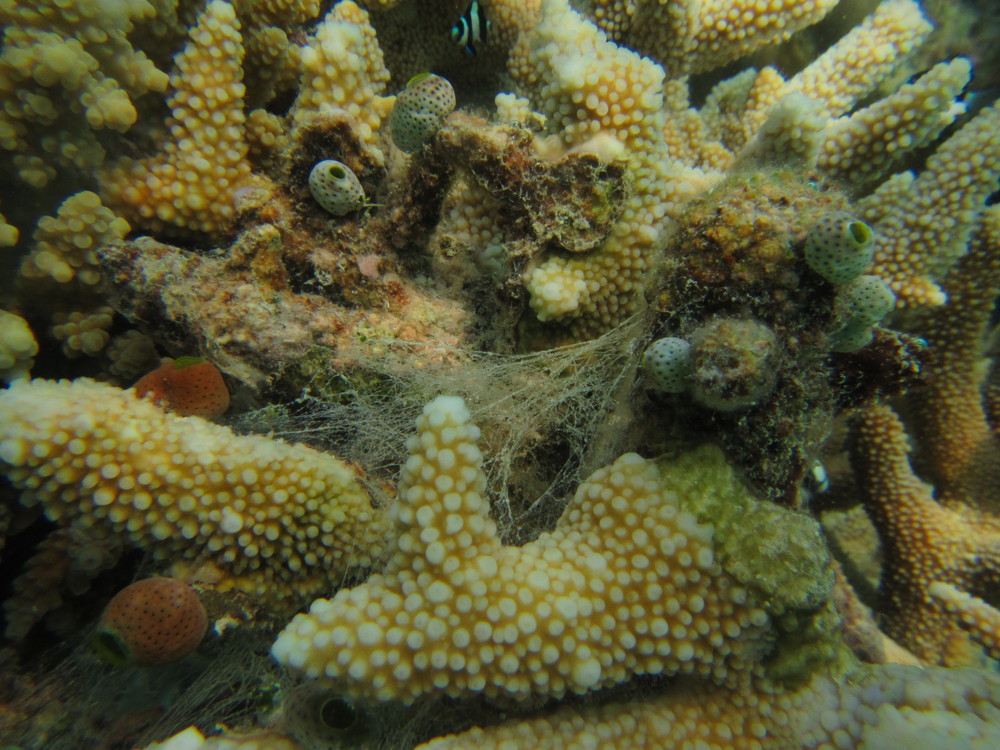
Do you know that even under the water we can find cobwebs? The invertebrate responsible for this mesh is not a spider, but rather a gastropod mollusk called Ceraesignum maximum. As all Vermeidae, this mollusk species is sessile and houses themselves within tubular shells. They are common dwellers of shallow water in coral reefs and rocky shores. These nets are called mucus nets that can expand around the individual up to 10 cm in diameter. Waves and currents fill the net with tiny particles. After a few hours the mollusk will inhale the net with all of its yummy goods caught inside.
Looking at your frame, you will see that it is doing amazing and the corals are really growing well since the last update even after the heated months and some stormy weather. We have done some recent maintenance on all the frames which include cleaning them, removing the invasive algae and coral predators to maximize growth. In the upcoming post we will show you close-ups of your frame and the coral fragments, with some interesting facts and findings about those that are on your frame. After 6 months you will see a similar post showing once again the progress of your frame.
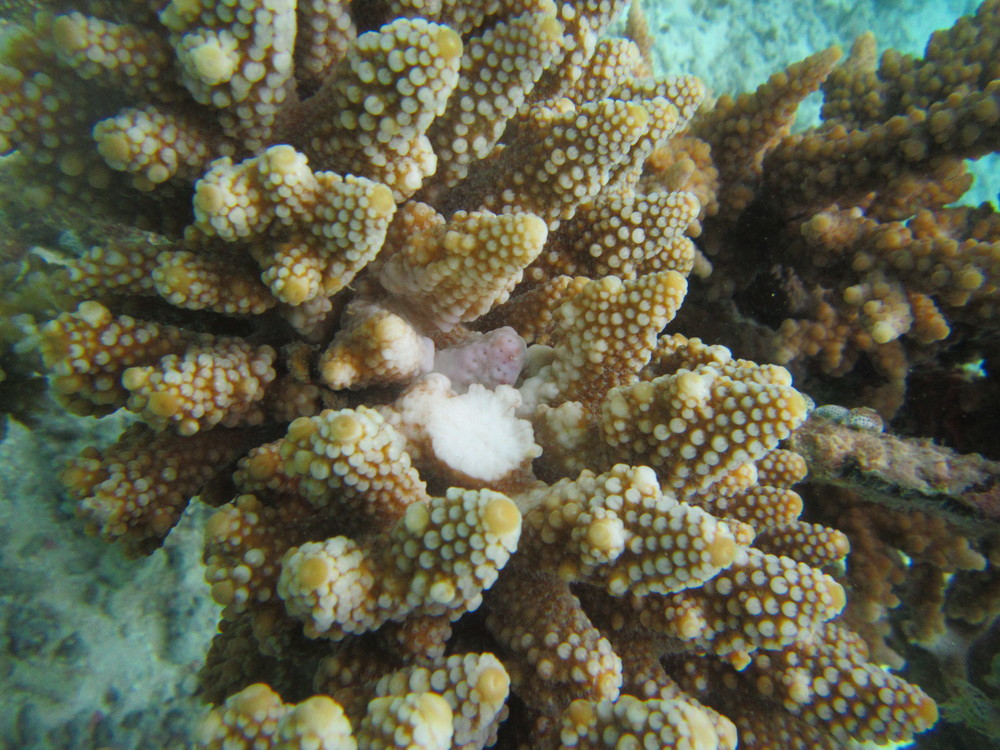
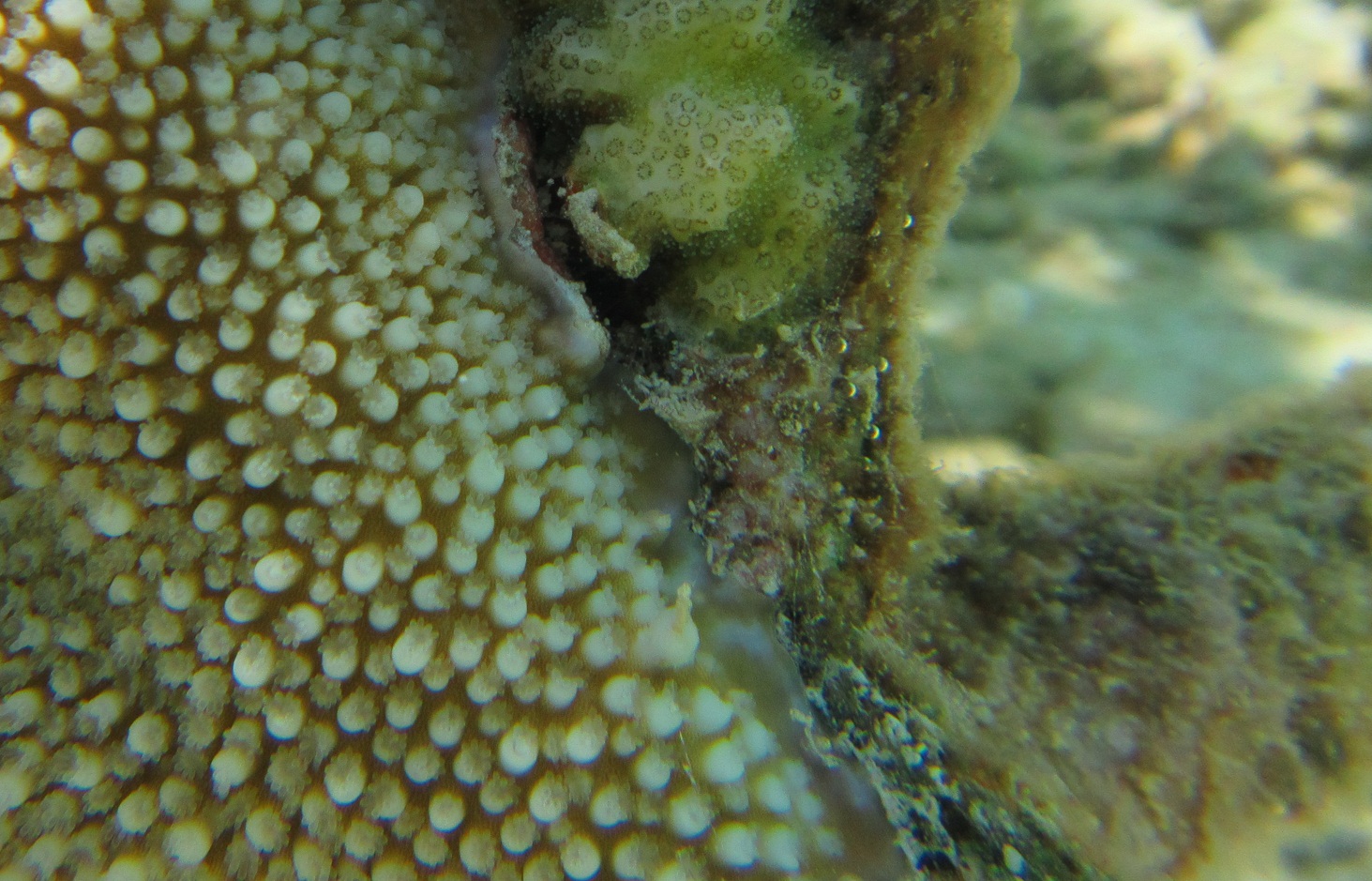
A fresh scar from a broken branch, the white indicate the calcium skeleton underneath that is produced by the tiny polys above year after year. Since collected fragments are picked up rather than broken down from existing colonies they often have dead sections covered with overgrowing algae and dead or damaged polyps, as such these sections are removed for faster recovery. You can already see the new polyps starting to grow along the bottom of the scar, soon the branch will regrow into its former state.
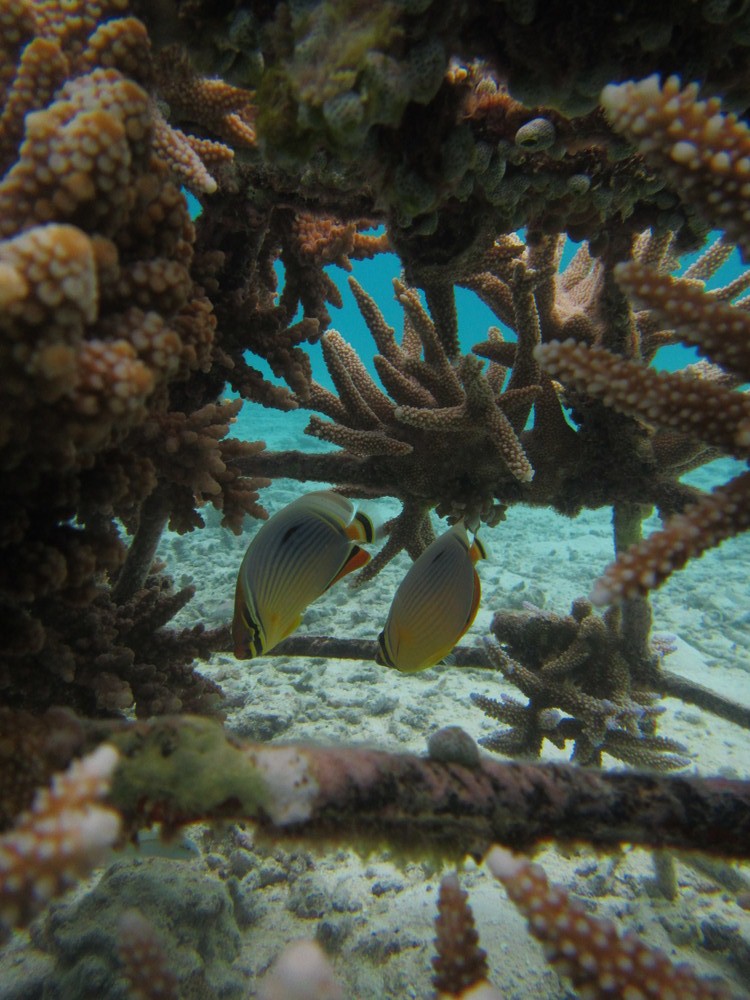
We found a special guest enjoying your frame last month … a Butterflyfish. The Butterflyfish family is very large with 10 genera and about 120 different species, with 32 species common in the Maldives. As Butterflyfish grow from juvenile to adult fish, their snout elongates and coloration changes significantly. These fish like to feed on plankton, algae that grow on corals and small invertebrates. The plankton feeding Butterflyfish like to swim close to the water surface in large groups, while the “reef-pickers” prefer to stay in pairs of two. Butterflyfish are commonly found near shallow reef flats or outer reef walls, you will rarely find a Butterflyish in depth exceeding 50 meters. We love seeing these colorful fish on your frame, they are keeping algae growth in check and are helping your corals to strive and survive.
Why are coral reefs so important? For once, coral reef are said to be one of the most diverse ecosystem on the planet and provide shelter and habitat for many marine organisms. Furthermore coral reefs take an integral part in nitrogen and carbon fixing and are a source of essential nutrients for the marine food web. But not just marine organisms benefit from coral reefs, they also play a crucial role in protecting the coastline from wave action, tropical storms and coastal erosion. Economically coral reefs are important to foster healthy and abounded fishing grounds, tourism as well as the creation of soil and solid substrate for construction.
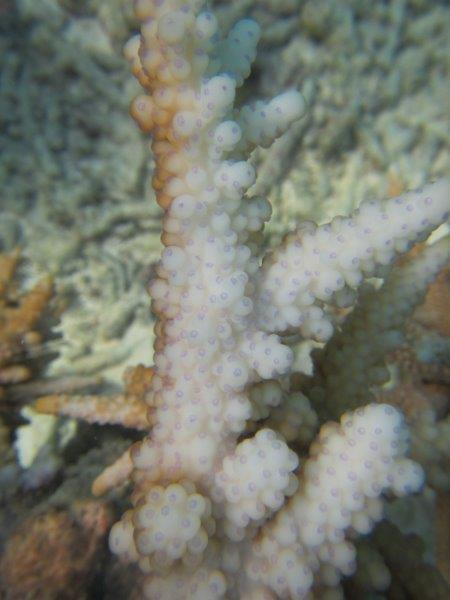
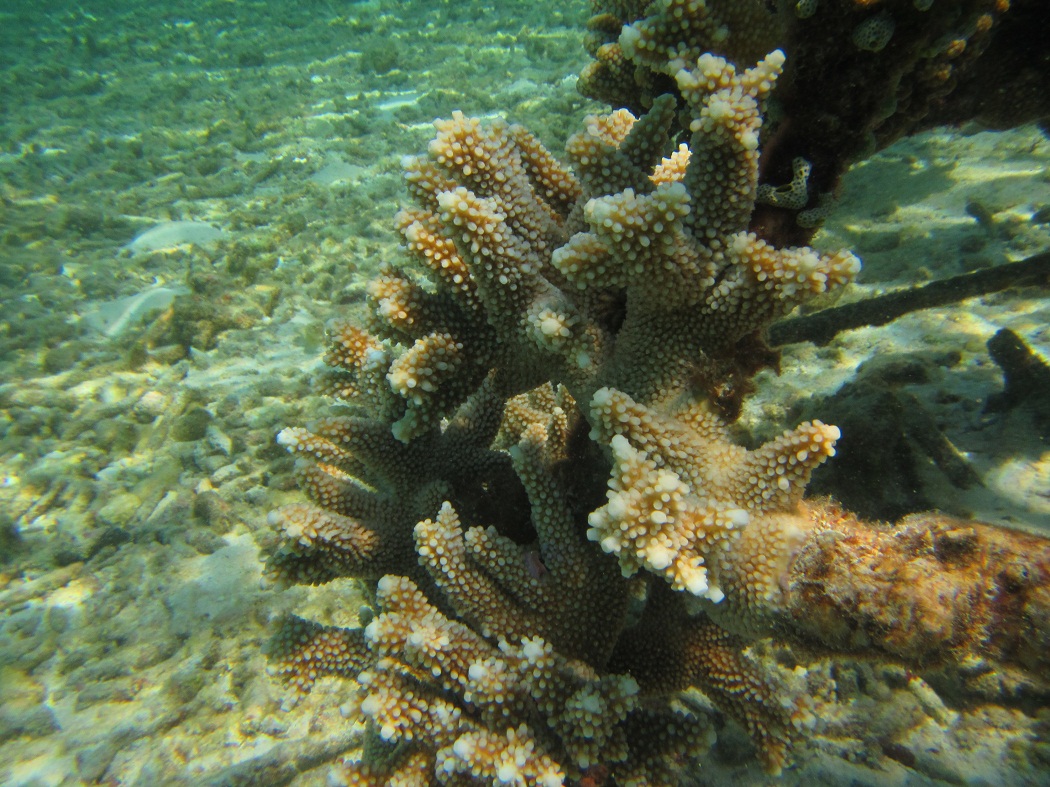
Looking at this species of Acropora on your frame, you will notice the white tips on the branches. When corals are stressed by changes in water conditions such as temperature, light intensity, or nutrients, they expel the symbiotic algae called Zooxanthellae, living inside their tissues, causing them to turn completely white, this is also known as coral bleaching. When a coral bleaches, it is not dead yet, but may soon starve if conditions persist, since the animals inside rely on this algae for its energy. If their stress levels are not severe, corals may recover. If the algae loss is prolonged and the stress continues, coral eventually dies. Here in the Maldives, the peak temperature is around March – June, when we also see some of the corals turn white, usually their colors return soon after if conditions don’t persist.
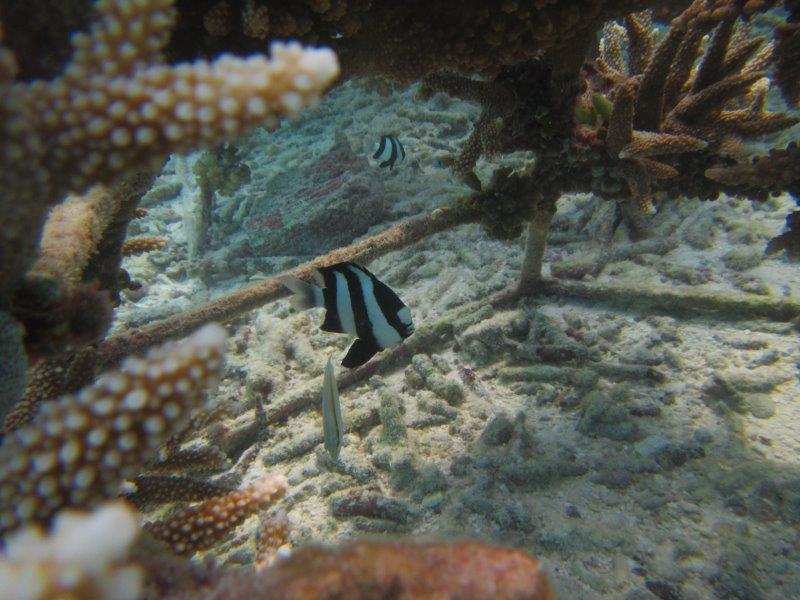
The Dascyllus aruanus, known commonly as humbug damselfish, has found in your coral frame its home. This particular fish is known by multiple common names, such as three stripe damselfish, humbug dascyllus, or black and white damselfish. They only reach an adult size of 3-4 inches (7.6-10 cm). Sporting three broad black stripes on a white body, the humbug damselfish has a zebra like appearance. The stripes run slightly off vertical through the eyes and mouth, midbody and bisecting the caudal peduncle, making it half black and half white. There are several contestants for the title of most important reef fish family, but the Damselfish are certainly one of the front-runners. Not only are there numerous species, but also many of these species are present on Maldivian reefs in prodigious numbers. The humbug damselfish that you can see in the picture is associated with isolated coral heads in sheltered inshore habitats. Like all damselfish, they can be territorial and aggressive, especially as they get older.
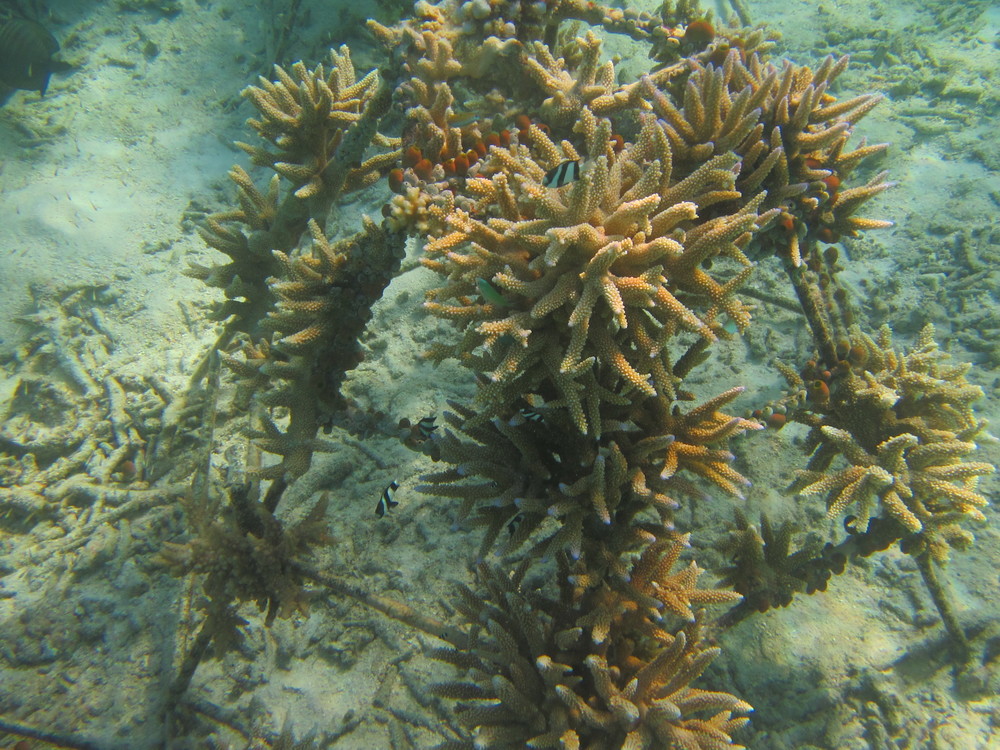
This is your 6 month frame progress update. Your frame is doing fantastic!
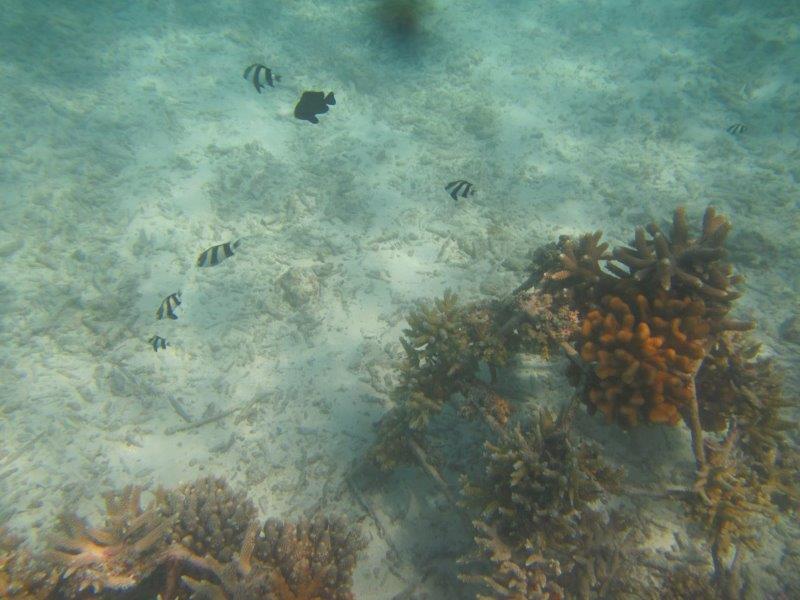
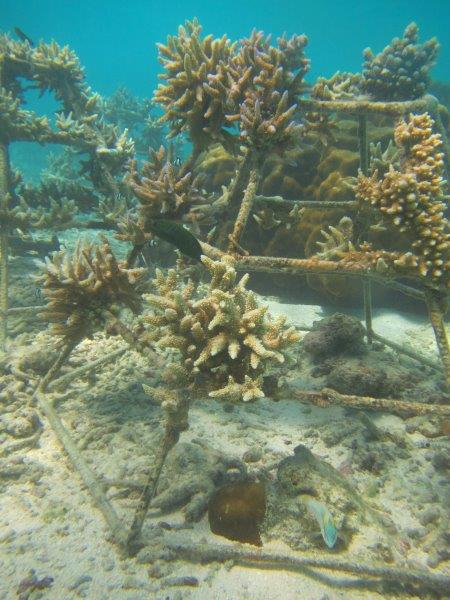
Looking at your frame, we can see lots of new growth, especially of the acropora corals (the branching & fast growing corals). We can see some of the corals are competing for space, which is a good problem to have, it means your frame is thriving. We can also see that your frame is contributing to the overall health of the coral ecosystem. We see lots of life such as little fish, crabs, worms and mollusks around your frame. Overall your frame has survived the warm months of March, April and May just fine, unfortunately some of the other frames in our colony weren’t so lucky.
Over the following months we will continue with maintenance to keep harmful algae and predators off your frame and to give your frame the best chance for successful growth.
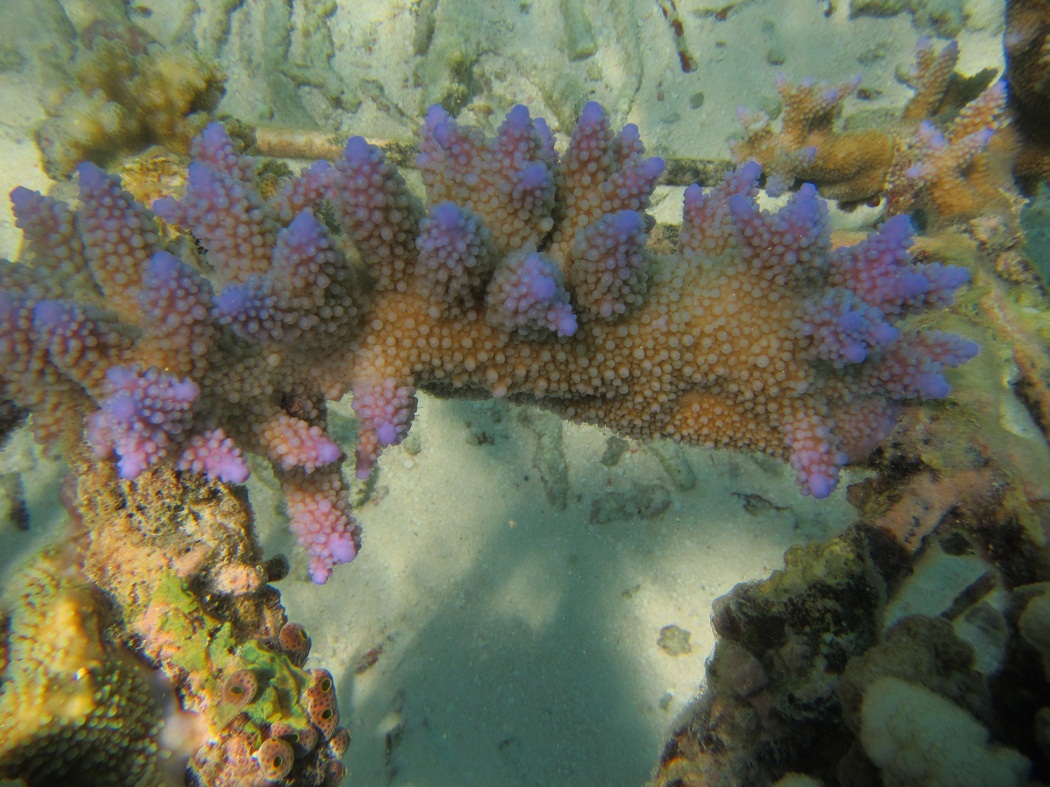
Have you ever wondered why some corals are more colorful than others… That is because some corals increase the production of colourful protein pigments (such as these purple tips) when they are exposed to more intense sunlight and this colony, of a branching Acropora, is simply amazing. Scientist have found that these pink, blue and/or purple proteins act as sunscreens for the corals by removing substantial light components that might otherwise become harmful to the algae hosted in their tissue. Corals rely on these light-dependent miniature plants, the so-called zooxanthellae, since they provide a substantial amount of food. Furthermore, these tips consist of a particular polyp called an “apical polyp”. It is responsible of the growth of the particular branch. For instance, it will reproduce asexually by cloning itself, potentially an infinite number of times throughout its lifetime. Here and there, one of the “radial polyps” will differentiate becoming a new apical polyp with its distinguished purple color, driving the growth of a new branch.
Humans get a sun tan – corals become more colourful.
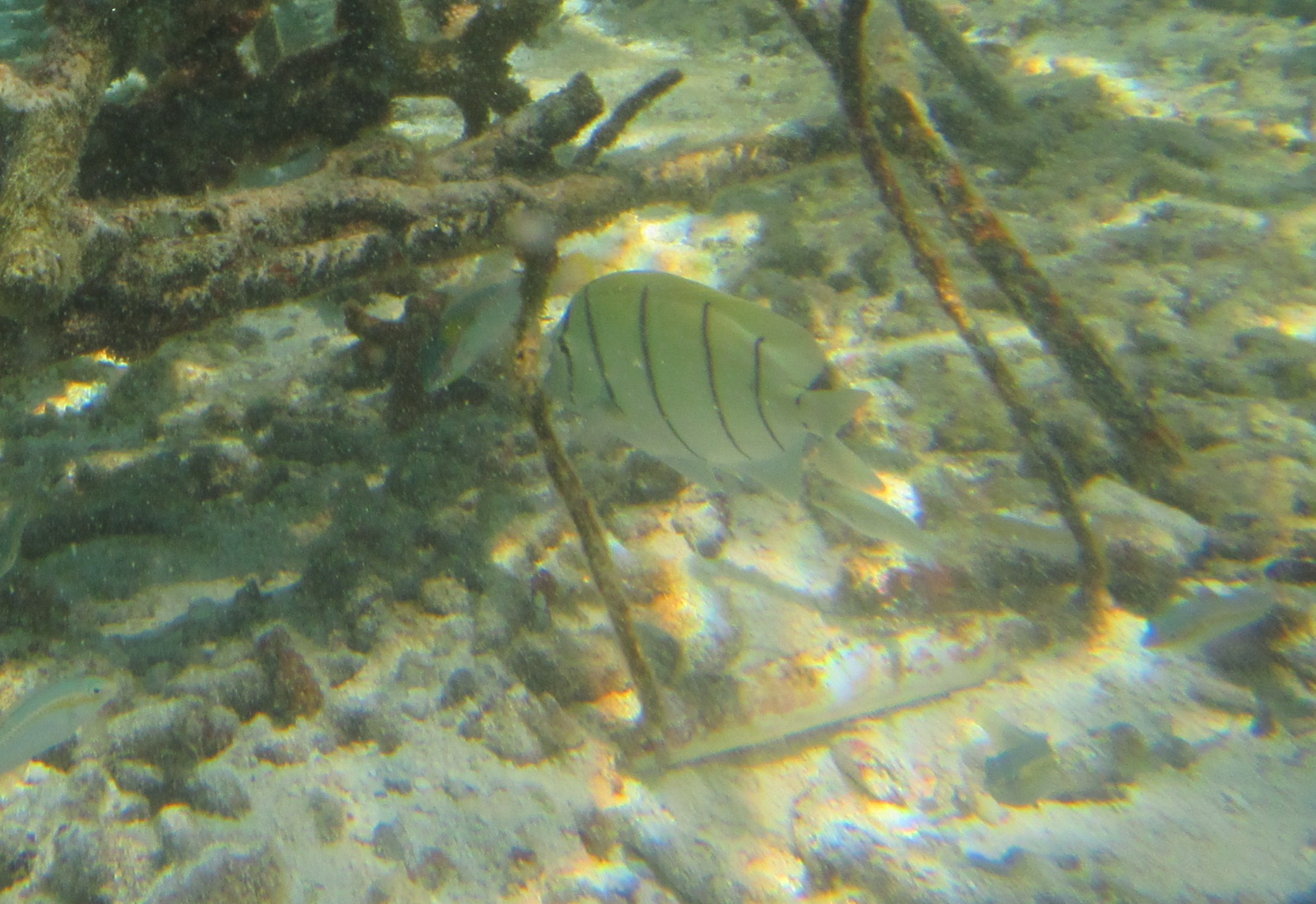
You coral frame is starting to be colonized by different fish communities. In this photo you can see a couple of wrasse and a convict surgeonfish (Acanthurus triostegus) in the background. This species of surgeonfish have a pale color with distinct vertical black stripes, including one going through each eye. Convict surgeonfish are often found in schools but also individually. This is an herbivorous species that actively grazes on algae found on rocks and corals. This continuous grazing on the algae helps to maintain the algae population
Coral reefs for the most part appear to be static environments, despite the presence of ever busy fish, this is because most of the activities happening within corals are invisible to our eyes. In fact, coral reefs are a dynamic environment where every cm2 may hide beauty or a fight for survival! Among the invisible, corals are surely the most active, by building the amazing structure which allow us to see paradise tropical islands! However, they are continuously fighting for the survival, against predators, disease and environmental changes, and even between them. They are supplied with microscopic needles and venomous tentacles to kill any other corals which may try to steal space and light! Here you will see similar species of Acropora on the top of your frame slowly growing towards each other with their branches, they may soon interact with each other and compete for the same space
How do corals grow bigger? Coral reefs are mainly built by stony or hard corals, together with their endosymbiotic algae (algae living into the corals), zooxanthellae. To give you some information on how the calcification process works. The main elements needed to build the skeleton are Ca2+ (Calcium ions) and DIC (Dissolved Inorganic Carbon). Both these elements are transported into a specific area of the coral called the “calcifying region”, which is situated under each single polyp. Here, the calcium carbonate (CaCO3) is formed throughout a chemical reaction. Finally, the calcium carbonate (or technically crystals of aragonite) is deposited to form the skeleton. The process involves the polyp’s cells and the zooxanthellae and by the mutualistic work of these two counterparts the skeleton is formed. However, if for any reasons (i.e. high temperature) one of the two parts is not working properly the process stops and the coral may die.
Coral reefs are built and made up of thousands of tiny animals called coral “polyps” that can live individually (like many mushroom corals do) or in large colonies that comprise an entire reef structure. A polyp has a sac-like body and an opening, or mouth, encircled by stinging tentacles called nematocysts or cnidae (imagine an upside down jellyfish). The polyp extracts calcium and carbonate ions from seawater to build itself a hard, cup-shaped skeleton made of calcium carbonate (limestone). This limestone skeleton protects the soft, delicate body of the polyp. Coral polyps are usually nocturnal, meaning that they stay inside their skeletons during the day. At night, polyps extend their tentacles to feed. Most coral polyps have clear bodies whereas their skeletons are completely white, like human bones. Generally, their brilliant color comes from the zooxanthellae (tiny algae) living inside their tissues. Several million zooxanthellae live and produce pigments in just one square inch of coral. These pigments are visible through the clear body of the polyp and are what gives coral its beautiful color.
We would love to tell you more about the coral colonies that live on your frame. There are more than 139 species in the Acropora genus, and the two colonies in the foreground of this photo belong to the species Acropora globiceps. Colonies are digitate and usually small. The size and appearance of branches depends on the degree of exposure to wave action, but they are always short and closely compacted. It can be yellow, green or cream in color. This species is very resistant to wave action and may dominate in very shallow, wave exposed water where the branches can be very stubby. It is important to raise awareness for this species and as such we use it for our Conservation Project since it is considered vulnerable to extinction by the International Union for Conservation of Nature (IUCN).